Inside Portland, OR’s Reggio-Inspired Classrooms: What High-Quality Practice Actually Looks Like
Quick Answer
At the heart of Reggio-inspired early childhood education is a focus on children and their unique way of exploring the world, through curiosity, creativity, and meaningful relationships. Your child will feel inspired to learn in a self-directed approach guided by our Reggio teachers.
The best Reggio-inspired programs in Portland show this in every corner of the classroom, in the materials available, the questions teachers ask, and the way children’s thinking is documented and displayed. This guide helps you know what to look for.
What You Notice First, and What It Means
Walk into a Reggio-inspired classroom for the first time and something feels different before you can name it. The room has a quality of intention. The materials are beautiful. Children are deeply absorbed. The walls show thinking, not decoration. Teachers are close to children, listening more than directing.
That feeling is not accidental. It is the result of a philosophy applied with care, and once you know what you are looking at, you can recognize it clearly. This guide walks you through what genuine Reggio-inspired practice looks like in Portland, so you can tour any program with confidence and know exactly what you saw.
What Makes Reggio-Inspired Learning Different
Reggio-inspired education is built on a belief that might surprise you: that children already know how to learn. A teacher’s job is not to fill them with knowledge. It is to follow their lead, create space for discovery, and listen deeply to what they are trying to understand.
That means learning in a Reggio-inspired classroom is emergent rather than prescribed. As NAEYC describes, when learning grows from the child’s own interests and guided exploration rather than a fixed lesson plan, it becomes genuinely individualized. The curriculum shifts based on what children are curious about, and teachers are observers and collaborators as much as they are instructors.
That is a meaningful shift from traditional early childhood models, and it changes what quality looks like when you walk into the room.
What High-Quality Reggio-Inspired Practice Looks Like Day to Day
The Environment as a Third Teacher
In Reggio-inspired programs, the classroom environment is considered a teacher in its own right. That means every corner of the room is intentional. In our classrooms, you’ll find a wide range of learning materials and tools to support hands-on learning within thoughtfully designed, nature-infused spaces that inspire creativity. Children can reach what they need independently, and the space communicates, quietly but clearly, that this is a place for serious, joyful work.
When you tour, notice whether the room feels purposeful and inviting, or cluttered and incidental. A well-prepared Reggio environment does not happen by accident.
Open-Ended Materials That Invite Thinking
Reggio-inspired classrooms prioritize materials that can become anything: loose parts, clay, natural objects, paint, light tables, fabric, and recycled materials. These are not craft supplies for a predetermined project. They are tools for children to express ideas, test theories, and make their thinking visible.
Ask what children have been making or exploring lately. A teacher in a genuine Reggio program will be able to tell you exactly, and will light up talking about it.
Documentation That Makes Learning Visible
One of the most distinctive markers of a Reggio-inspired program is documentation: the practice of capturing children’s learning through photos, transcribed conversations, sketches, and displayed work. This is not decoration. It is a record of children’s thinking over time, and it tells children that their ideas are worth preserving.
Look at the walls during your tour. Do they show evidence of process and thinking, or are they filled with identical craft projects? That difference tells you a lot.
Teachers Who Ask More Than They Tell
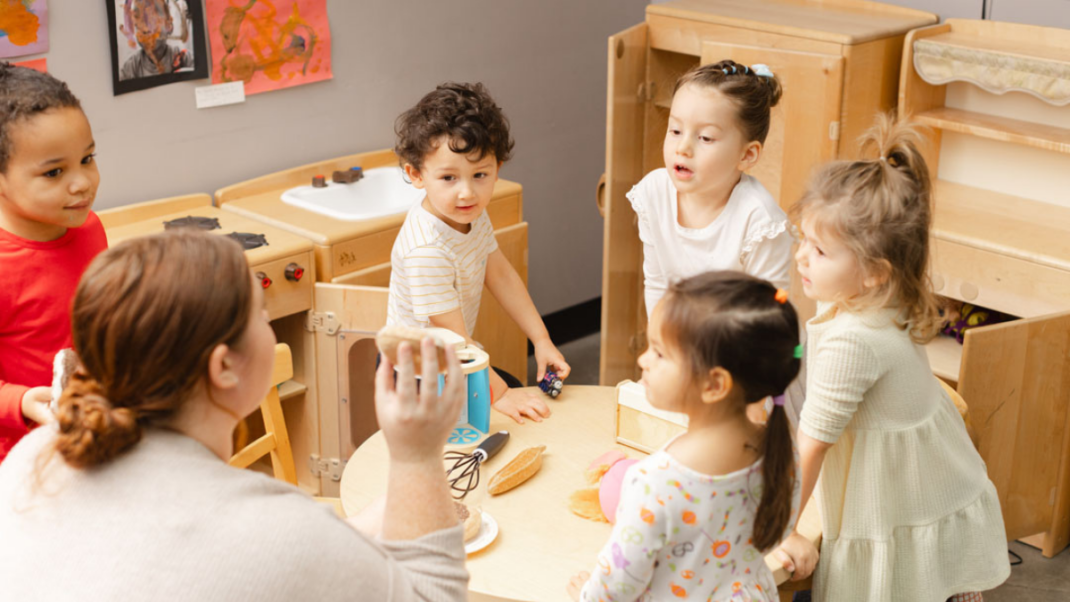
In a Reggio-inspired classroom, educators act as facilitators and co-learners, learning alongside children while providing an environment rich with opportunities for collaborative discovery and shared inquiry. What do you think is happening? What would happen if we tried it a different way? How could we find out?
This takes real skill and a genuine belief that the child’s thinking matters. Watch how teachers interact with children during your tour. Are they talking at children or thinking alongside them?
Projects That Follow the Child’s Lead
Long-term projects are a hallmark of Reggio-inspired programs. These are extended investigations that emerge from children’s genuine interests and unfold over days or weeks. A class might spend a month exploring shadows, or building an elaborate city out of recycled materials, or investigating how water moves.
Ask about current or recent projects during your tour. How they describe that work will tell you whether the school is truly following children’s interests or simply naming an approach.
What the Classroom Should Feel Like
Walk into a genuine Reggio-inspired classroom and the feeling is distinct. Here is what to look for:
- A room that feels beautiful and intentional, with natural materials, light, and order
- Documentation panels on the walls showing children’s thinking over time, not identical crafts
- Open-ended materials that are accessible, organized, and clearly used regularly
- Children who look absorbed and purposeful, engaged in self-directed work
- Teachers who are present and listening, not managing from the front of the room
- Evidence of long-term projects: work in progress, sketches, collections, evolving displays
If the room looks like any generic preschool classroom with a Reggio label on the door, that is worth noting. The philosophy is visible when it is real.
The Role of Families in a Reggio-Inspired Program
In authentic Reggio-inspired programs, families are considered an essential part of the learning community, not just an audience for it. You should expect regular, substantive communication about what your child is exploring and thinking about. Not just updates, but invitations into the work.
Ask how the school communicates with families about children’s learning. Ask whether families are invited to contribute ideas, materials, or expertise to ongoing projects. A program that takes family partnership seriously will have specific, concrete answers.
Frequently Asked Questions About Reggio-Inspired Learning in Portland
These are the questions families ask most often when evaluating Reggio-inspired programs. We have answered them here so you can come to a tour already informed.
What is Reggio-inspired learning, exactly?
Reggio-inspired learning is an approach to early childhood education that views children as naturally curious, capable learners whose interests should drive the curriculum. Teachers observe, listen, and build learning experiences around what children are genuinely exploring. NAEYC describes this as emergent curriculum: learning that grows from the child’s guided exploration rather than a predetermined lesson plan. It is intentional, but it follows the child.
Is Reggio-inspired learning the same as unstructured play?
No, and this is one of the most common misconceptions. Reggio-inspired classrooms are highly intentional. Teachers plan carefully, prepare environments with purpose, and ask questions designed to deepen children’s thinking. The difference is that the content of the learning emerges from children’s interests rather than a fixed curriculum. There is always purpose and care behind the experience, even when it looks like free exploration.
How do I know if a school is genuinely Reggio-inspired or just using the label?
Ask about current projects. A genuinely Reggio-inspired teacher will be able to describe what children have been investigating, how the project started, and where it is going. Look at the walls: documentation panels showing children’s thinking over time are a strong indicator. And watch the teachers during your tour. If they are asking open-ended questions and talking about children’s ideas with genuine enthusiasm, that is the real thing.
Will my child learn academic skills in a Reggio-inspired program?
Yes. Reggio-inspired programs develop academic skills through investigation and project work rather than drills and worksheets. Children develop literacy through storytelling, documentation, and conversation. They develop mathematical thinking through building, sorting, and pattern-making. The skills are there, embedded in meaningful context rather than isolated exercises, which research consistently shows leads to deeper and more lasting learning.
Come See It for Yourself
Touring a school is the best way to understand whether it truly lives out these principles. The classroom should feel alive with purpose. Teachers should be able to speak clearly about what children are learning and why the room is set up the way it is. And your child should walk in and feel an immediate pull toward something that makes them want to explore.
Join our community of co-constructors. At Kozy Kids Enrichment Center in Portland, we believe children are capable thinkers deserving of beauty and respect. Schedule a tour to experience our child-led discovery in person.
Related Posts
All Posts
Reggio-Inspired Learning at Home in Portland, OR

The Reggio Emilia Approach in Portland, OR: How to Choose a Reggio-Inspired Preschool at Kozy Kids